History
St Edward's - A caring Christian Community where children achieve their potential, are confident in themselves and their abilities and are set on a positive path for life.
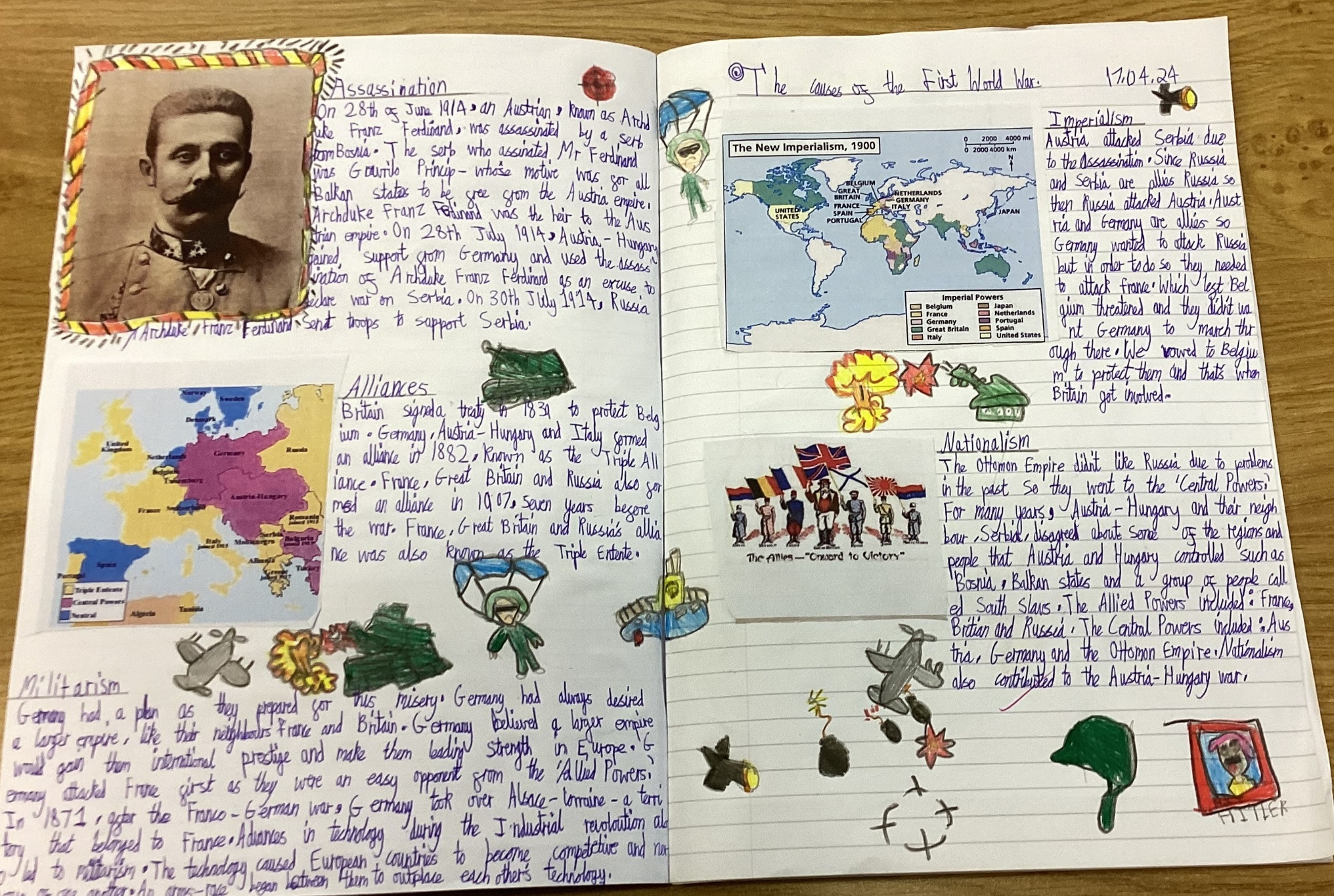
At St Edward’s, our children love History! There is always a tangible 'buzz' in classrooms as children learn about the lives of Victorian school children, the many wives of Henry VIII and the experiences of soldiers in the trenches of World War I. Children are naturally fascinated by the events of the past, and it is our ambition to nurture this curiosity and equip St Edwards' children with the skills and knowledge to become life-long historians.
We believe that history allows children to begin to understand their place in our world, considering what and who has come before them.
We want our children to develop a coherent chronological narrative and develop historical concepts such as cause and effect, considering how their lives and those of others have been impacted.
History allows children to develop their understanding of and appreciate how others may have had to make sacrifices to allow them to live the life they lead today.
They can begin to understand that the past has many facets and that each era is different from the next. Children will develop an understanding for the wider world but also Britain and how it has influenced and been influenced by the wider world.
We aim for our children to be able to be analytical, critical thinkers with a secure understanding of chronology.
A people without the knowledge of their past history, origin and culture is like a tree without roots.
Marcus Garvey
The core threads of the St Edward’s History Curriculum:
When selecting the knowledge and skills most appropriate for our children, we wanted to ensure that our decisions were informed by our overall vision and values for the school.
The St Edward's values are taught and reinforced within the context of our history curriculum:
- Thankfulness
- Compassion
- Peace
- Forgiveness
- Perseverance
- Friendship
With this in mind, we identified key threads which would run through our history curriculum.
These key threads tie together our vision, values, National Curriculum requirements and meet the needs of our pupils;
|
|
Being a Historian (skills)
|
|
|
People, Places and Events (Knowledge)
|
|
|
Change (Skills and Knowledge)
|

At St Edwards we define History as: the study of significant people, places and events of the past.
History Topics
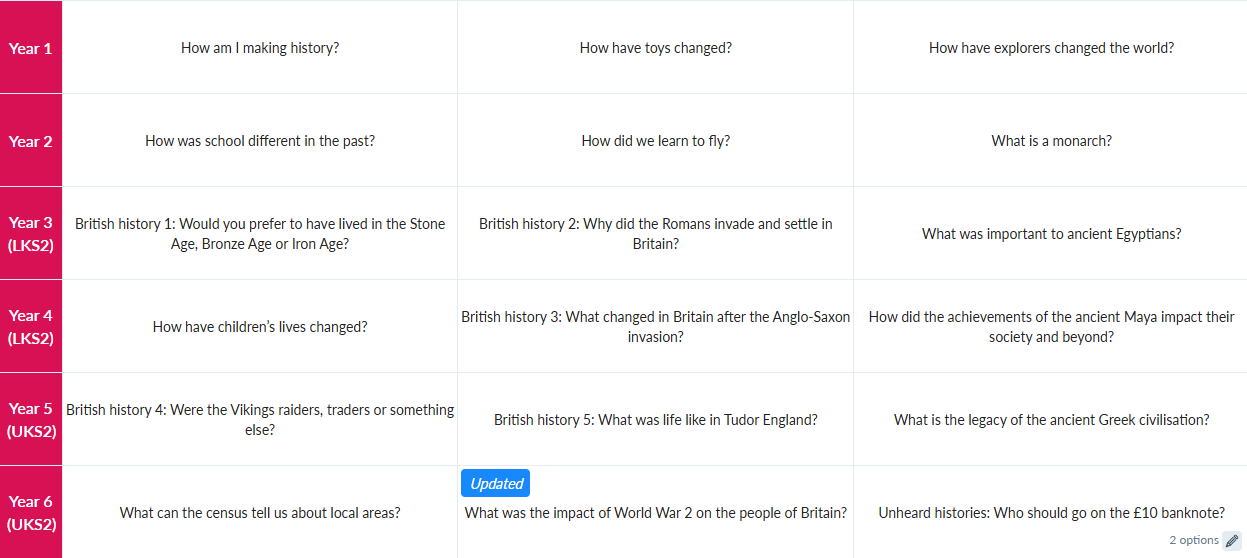
We alternate the teaching of History and Geography each half-term.
A Curriculum for Our Children
We have identified some core barriers that the children of our school face when they are accessing the curriculum, and we intend to deliver the history curriculum with an approach that addresses these:
- Vocabulary – we ensure that our topics are planned with careful and deliberate vocabulary progression. Teachers display relevant vocabulary and refer back to the displayed words throughout a unit of work.
- Communication and teamwork skills – our history curriculum allows for plenty of discussion. Children are encouraged to ask questions and give verbal explanations. The use of subject-specific vocabulary is modelled, and children are sometimes provided with sentence stems.
- Resilience – we design challenging tasks in our history curriculum, allowing children to experience failure and errors in a safe environment, scaffolded by the implementation of growth mindset training
- Differing and sometimes limited life experiences – We offer a curriculum of breadth and wider opportunity. We provide children with opportunities to expand their knowledge and experience of history beyond the classroom through: trips out of school to support learning; recognition of Remembrance events;
A Curriculum for All Children
Ambition
Our ambition in History for children with SEND is broadly in line with our ambition for all children.
We believe that we need to be ambitious about what our children with SEND can achieve and not believe their ability is ‘fixed’ for every subject. Yes, we should take into consideration their barriers to learning but we shouldn't let these limit their opportunities - just because they find reading difficult, it doesn't mean that they won’t be able to interpret Ancient Egyptian hieroglyphics or develop a strong sense of chronology.
Access (How we ensure all children can access and succeed in History)
-
At the start of units and lessons, children revisit prior knowledge and vocabulary.
-
Children have visual knowledge organisers which map out the key knowledge and vocabulary within each unit of work. These can be used for pre-teaching new vocabulary prior to the lesson, to help children visualise the concepts they are using in class and can help with spelling and writing activities.
-
Check in - For children with SEND, a history lesson can be overwhelming with all the new information they are given as well as trying to comprehend ideas that may be very alien to them. Teachers and TAs make a point of checking in with these children and offering further support or scaffolding where necessary.
-
Working walls - Images and facts are displayed on working walls and teachers refer to these regularly.
EYFS
In Reception, children are taught about history through, ‘Understanding the World’ which gives children the foundations for a history curriculum in year 1. The Early Learning Goals are delivered through topics.
In EYFS, history is about developing the initial concepts of past and present, and people, culture and communities. Teachers are aware of the content to be delivered in subsequent year groups, and endeavour to lay down the foundations for future learning.
Children start their historical learning journey by focusing first on their own lives and then that of those who are important around them including their families. They make comparisons between now and then and develop their understanding of ‘past’. This is then reinforced and supported through listening to a broad selection of stories, non-fiction, rhymes and poems.
History-specific vocabulary is introduced which further prepares them for learning in year 1 and beyond.
Assessment in History
At St Edward's, we believe that assessment in history should be purposeful, manageable and valuable in informing future teaching and learning. Teachers use formative assessment strategies throughout every lesson to check pupils’ understanding, develop historical thinking and identify misconceptions. In addition, teachers use assessment folders containing carefully designed grids to monitor pupils’ understanding across lessons and units of work. These grids enable teachers to identify pupils who may have been absent, experienced difficulty with key historical concepts or require further support and reinforcement.
By regularly tracking this information, teachers can identify patterns and gaps in understanding, allowing them to revisit key knowledge, adapt future lessons and plan effective next steps to ensure all pupils make progress in history. Teachers are also given opportunities to reflect on pupils’ progress in history alongside members of the Senior Leadership Team during pupil progress meetings, ensuring assessment information is used effectively to support achievement for all learners.